Informal traffic director managing a blackout in Johannesburg
photographystreet_scene
Förstora
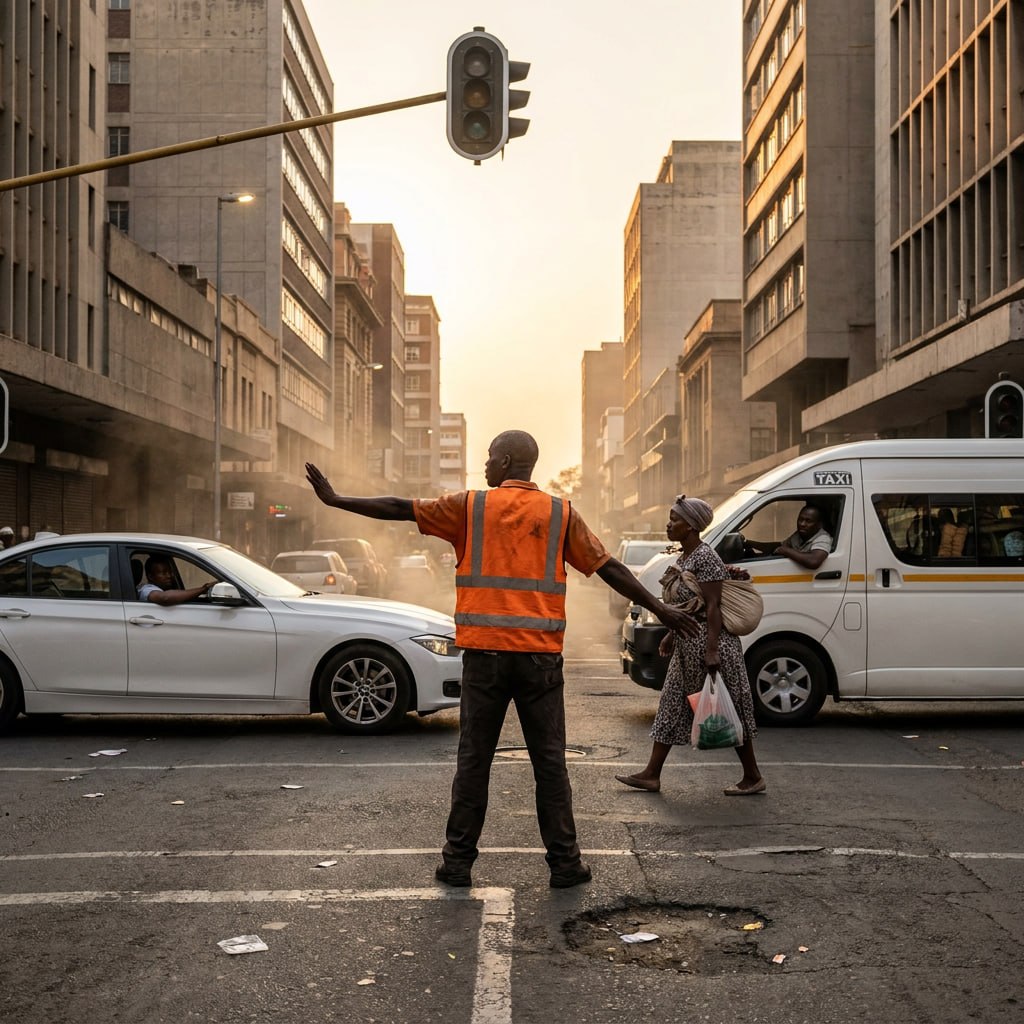
A photorealistic candid street photograph shot from the pavement on one corner of a Johannesburg CBD intersection, from about ten meters back at chest height, late afternoon.

A man in an orange high-vis vest stands in the middle of the junction directing traffic with absolute conviction. Both arms are committed: one held flat and rigid toward the stopped lanes in an unmistakable halt, the other sweeping across his body in a wide waving motion to bring the crossing pedestrian through. His chest is out, chin up, weight planted. He has the bearing of a man who has been given command of something. He has no authority whatsoever. He is an informal car guard who stepped into the intersection when the lights went dark and everyone simply started obeying him.

The traffic lights above him are completely unlit, their glass dead and grey against the sky. Load shedding. That detail is the whole explanation and it has to be visible.

A white BMW sedan sits stopped at the stop line, nose slightly over it, the driver's hands at the top of the wheel, watching the man and waiting. Beside it a minibus taxi has also stopped, sliding door shut, the driver leaning on his elbow out of the window, patient, not hooting. The taxi is packed, faces visible through the windows. Behind them a second row of cars has queued up. Nobody is pushing forward. Nobody is arguing.

A woman crosses in front of them on his signal, walking steadily, a bundle wrapped and tied high on her back and a plastic shopping bag in one hand. She is not hurrying and she is not looking at the cars. She has been waved through and that settles it.

Late afternoon sun comes in low across the intersection, raking through exhaust fumes and street dust so the air itself is visible as a warm golden haze. The haze separates the layers: the car guard sharp in the foreground light, the cars behind him softer, the tall CBD buildings behind them softer still, their upper floors catching the last bright sun while the street below sits in deep shadow. His orange vest blazes where the sun hits it, the single brightest thing in the frame.

The intersection surface is worn asphalt with faded lane markings, patched potholes, a drain cover, scattered litter in the gutter. Street-level shopfronts with roller shutters, burglar bars, a hawker's table on the far corner, a man pushing a trolley of flattened cardboard along the pavement.

Shot at 50mm f/4, ISO 400, 1/500s on a mirrorless camera. The car guard is tack-sharp with the cars and the crossing woman acceptably sharp behind him, the buildings and the far traffic dissolving into warm hazy layers. The fast shutter freezes his flat halting hand and the mid-stride of the woman crossing.

The palette is warm and dusty, golden light through particulate air, grey asphalt and concrete, white car paint, the vest a single blaze of safety orange. No legible text anywhere, no number plates, no shop signage, no taxi route boards readable.

The composition puts the car guard at dead center, arms spread wide across the frame, with the stopped cars at the left third, the crossing woman at the right third, and the dead traffic lights hanging unlit above his head. The eye goes to him first because he has the posture of a man in charge, then finds the dark traffic lights, and the picture explains itself. The mood channels Garry Winogrand's street energy: a city that lost its power supply and quietly agreed to be governed by a volunteer in an orange vest.